
Single vs multi-cartridge filtration systems
Cartridge pool filters are available in two configurations. Single-cartridge units are suited to small pools, spas and compact installations where the debris load remains limited. Their filtration surface is modest, and the cartridge may require more frequent cleaning in exposed environments.
Multi-cartridge systems significantly increase the filtration surface by housing several cartridges within a single unit. This configuration handles higher flow rates and greater debris capacity, making it the appropriate choice for medium and large residential pools. It is also the configuration most often specified in architectural projects where cartridge filtration is chosen for its low water consumption and compact footprint.
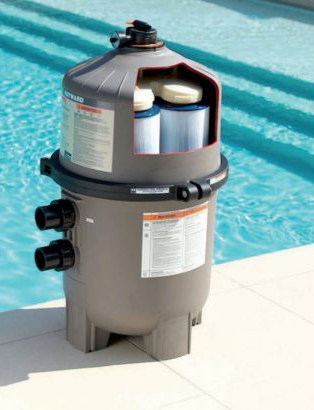
How a cartridge pool filter works
Cartridge pool filters rely on mechanical filtration. Water passes through a pleated filtering element – typically polyester or a similar synthetic fibre – designed to capture suspended particles while maintaining stable circulation flow.
The pleated structure dramatically increases the effective filtration surface, allowing the system to retain fine particles without restricting water flow. In a standard pool hydraulic circuit, the pump draws water through the skimmers and bottom drains, pushes it through the cartridge housing, and returns filtered water to the pool through the circulation inlets.
Cartridge filters typically achieve filtration between 15 and 20 microns – finer than traditional sand filtration systems, which generally operate between 30 and 50 microns depending on the media and operating conditions.
Integrating cartridge filtration into the pool hydraulic circuit
A cartridge filter is installed downstream of the circulation pump and upstream of any heating or chemical treatment equipment. In overflow pool configurations, the pump draws water from the balancing tank rather than directly from the pool basin.
Because cartridge filters present low resistance to flow and a large filtration surface, they operate efficiently at moderate circulation speeds. This makes them compatible with variable-speed pump systems, which are increasingly specified to reduce energy consumption.
A cyclonic pre-filter installed upstream of the pump adds a further layer of protection. By capturing heavier particles – sand, leaves, coarse debris – before they reach the pump impeller and the cartridge media, it reduces clogging and extends the interval between cartridge cleaning. In pools surrounded by vegetation or exposed to wind-driven debris, this addition significantly improves the efficiency and longevity of the filtration system.
Benefits and limitations of cartridge filtration
The primary advantage of cartridge filtration is its fine particle capture – 15 to 20 microns versus 30 to 50 microns for sand. This contributes to improved water clarity, particularly in pools where a calm, reflective surface is part of the design intent.
The second advantage is water conservation. Cartridge filters require no backwashing. Maintenance consists of removing the cartridge and rinsing it with a hose. Over a swimming season, overall water consumption can be around ten times lower than with a sand filtration system. For projects where pool filling cost and water sourcing are part of the design brief, this connects directly to the wider question of water management on site.
The third advantage is footprint. A multi-cartridge filter housing is substantially more compact than a sand filter tank of equivalent flow capacity. In plant rooms where every centimetre counts – urban terraces, rooftop installations, compact garden settings – this dimensional advantage can determine whether the filtration system fits within the available technical space.
For pools with regular staff maintenance, cartridge filtration also eliminates the operational risk associated with sand filter backwashing. Backwash cycles carried out too frequently, too late, or incorrectly discharge several hundred litres per cycle. Over a season, this represents a significant and avoidable water loss. With cartridge filtration, that variable is removed entirely.
Limitations exist. In pools with a heavy debris load – wooded environments, significant dust exposure – cartridges may require more frequent cleaning. The maintenance process requires physically removing the cartridge rather than operating a valve. This should be factored into the maintenance specification for each project.
Selecting and specifying cartridge filtration
Cartridge filtration should be specified as part of the pool’s overall hydraulic design, not selected in isolation.
The first parameter is filtration surface area. Multi-cartridge systems are generally preferred for residential pools of medium size and above, providing greater capacity and longer intervals between cleaning. The filter must be sized to handle the circulation pump’s flow rate without creating excessive resistance – oversizing the filtration surface is preferable to undersizing it.
The choice between sand and cartridge filtration should always be evaluated within the full hydraulic strategy of the pool – pump configuration, circulation layout, overflow system and maintenance regime – rather than on equipment cost alone.
Morana's advice
A cyclonic pre-filter installed upstream of the pump is one of the simplest ways to extend cartridge filter performance. It removes heavier particles before they reach the filtration media, protecting the pump impeller and reducing maintenance frequency. In pools with significant debris exposure, this addition changes the maintenance equation considerably.
Frequently Asked Questions: Cartridge pool filter
Does a cartridge pool filter require backwashing?
No. You remove the cartridge and rinse it with a hose. That avoids the water a sand filter sends to waste at each backwash, several hundred litres a cycle, and it simplifies the maintenance.
Is a cartridge filter suitable for a large overflow or infinity pool?
Yes, when it is specified for the flow. A multi-cartridge housing can take the flow of a medium or large residential pool, including an overflow pool. It has to match the circulation pump. On an overflow pool, the filter sits downstream of the balance tank pump.
What is a cyclonic pre-filter and is it necessary?
It is a separator placed before the pump. It removes heavier particles, sand, leaves and debris, before the water reaches the cartridge. It is not mandatory. On a pool with a lot of debris, it reduces clogging, lengthens the time between rinses, and protects the pump impeller.