
How an overflow pool manages debris
When the filtration system is running, all surface water is directed toward the overflow gutter. Unlike a conventional pool – where skimmers collect debris only within their immediate draw radius – an overflow pool evacuates the entire water surface through a continuous collection channel. Floating particles, oils and fine matter are removed across the full perimeter.
Below the surface, the floor inlets create an ascending current throughout the basin. This upward flow lifts settled particles into suspension, from which they rise to the surface and are evacuated through the overflow gutter. In a conventional pool, fine debris settles on the floor and remains there until a cleaning device collects it. In an overflow pool, the hydraulic circuit actively works against that settlement.
This is not a feature of the cleaning equipment. It is a structural consequence of the overflow design itself.
The in-floor cleaning system
The in-floor cleaning system is the coherent specification for an overflow pool – and its logic is directly compatible with the pool’s existing hydraulic circuit.
A sequencing valve in the plant room directs pressurised water to cleaning heads set flush into the pool floor. During each cleaning cycle, a group of heads rises briefly and projects a jet across the basin, directing settled debris toward the main drain. This action reinforces the ascending current already created by the floor inlets – the two circuits work in the same direction, increasing the volume of particles lifted into suspension and evacuated through the overflow gutter.
There are no submerged electrical or electronic components. The system operates on water pressure alone. Depending on the filtration pump’s flow rate, it can connect directly to the existing circuit – a dedicated pump is not always required.
Programmable in-floor cleaning systems deliver fully automated cleaning cycles. From the water surface, the pool floor remains visually uninterrupted.
What the specification requires
The pipe runs are embedded in the pool slab, and the sequencing valve is installed in the plant room at the construction stage. This hydraulic infrastructure must be designed alongside the pool’s filtration and overflow circuit – before the shell is cast. Retrofitting after construction requires significant structural intervention.
For clients commissioning an infinity or a zero-edge pool, specifying an in-floor system at the design stage is both technically sound and cost-effective.
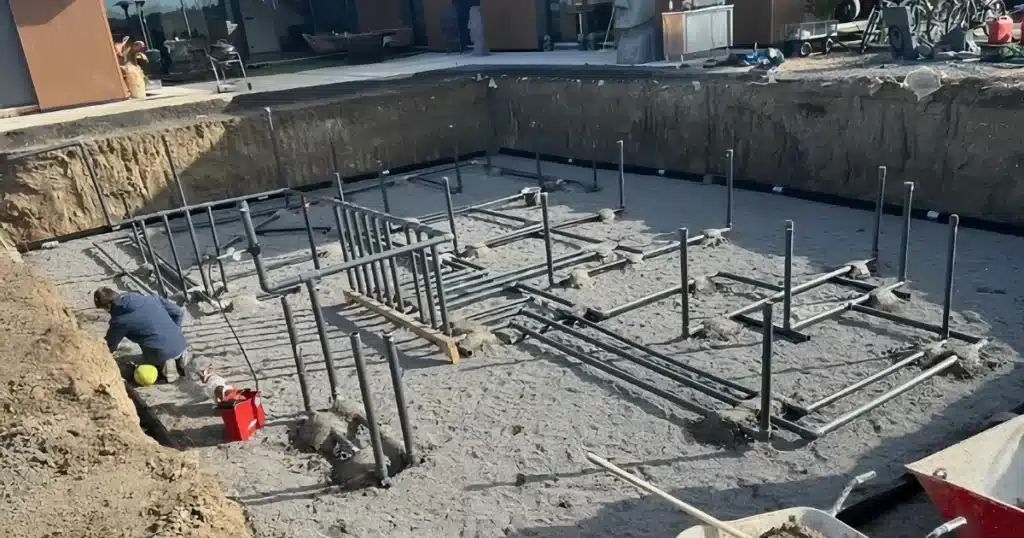
Retrofitting an in-floor system to an existing overflow pool is technically possible but costly. The pipe runs are embedded in the pool shell, and the sequencing valve requires space in the plant room — both ideally specified before the hydraulic drawings are finalised. Adding the system after construction requires structural intervention and is significantly more expensive than integrating it at the build stage.
The robotic cleaner – an alternative with constraints
A robotic pool cleaner is an autonomous unit that navigates the pool floor and walls independently of the filtration circuit. It collects debris in an onboard canister and connects to a standard electrical supply.
For an overflow pool, it presents three practical constraints.
It must be placed in the water before each cleaning cycle and removed afterwards – an operational demand that a permanently installed system does not impose.
Its onboard electronics are exposed to water and pool chemistry, which affects long-term reliability and determines its effective service life.
And the cumulative cost of replacement or repair can exceed that of a correctly specified in-floor system over the same period.
A robotic cleaner has no embedded infrastructure and can be acquired at any stage. That flexibility is its primary advantage. It is not, however, the appropriate primary cleaning solution for an architectural overflow pool.
Morana's advice
The hydraulic layout of an in-floor cleaning system is designed for each pool individually. The pipe network must ensure complete floor coverage – every zone of the basin is reached by at least one cleaning head. This is not a standard calculation; it depends on the pool’s geometry, depth profile and the position of the main drain.