
The beach entry pool, also called zero-entry, replaces steps and ladders with a gradual slope into the water. Suited to overflow and skimmer pools alike, it raises questions of design, hydraulics, slope ratio, and material selection that are worth addressing from the outset.
A beach entry pool: a modern alternative to pool ladders
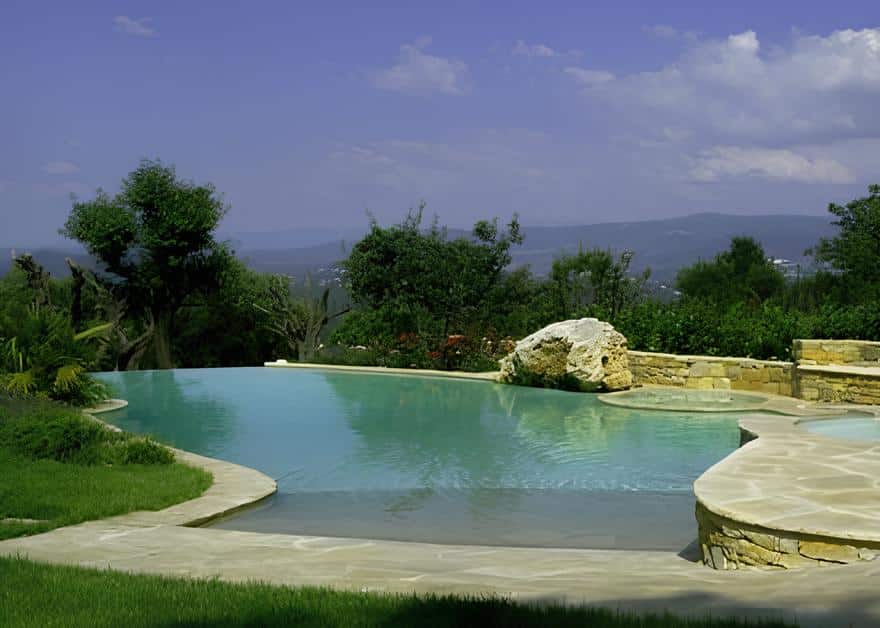
A few decades ago, accessing a pool meant stepping down a cold, vertical ladder. Today, that experience has been transformed. The beach entry offers a wide, gently sloping surface that mimics the natural shoreline of a lake or the sea – a soft invitation into the water that redefines comfort. This approach is perfectly suited to both overflow pools and skimmer pools, making it a flexible design option for many types of projects.
What makes a beach-entry pool so unique?
Rather than steps or abrupt changes in depth, a beach-entry pool creates a fluid continuity between the terrace and the water. The gradual slope becomes both a visual and physical extension of your outdoor space. It’s a concept that evokes the beauty of a Polynesian lagoon in a free-form pool but can just as elegantly complement a geometric, contemporary design.
The shallow submerged area at the start of the slope serves multiple purposes. It creates an inviting space to lounge, dip your toes, or enjoy a sun-soaked nap close to the water’s edge. For young children, it offers a playful, gently supervised area to splash and explore, always under adult supervision.
The advantages of the zero-entry pool
Shallow and safe
Very popular with parents of young children, this area with a small volume of water allows the youngest to gain confidence in the water environment without risk. In addition, the water temperature is much more pleasant.
Note: We remind you that children should continuously be under the watchful eye of an adult.
The beauty and conviviality of a zero-entry pool
Integrating an in-water deck into a semi-in-ground or in-ground pool project adds a distinct dimension; it is visually stunning. Your pool is not only a place to swim but also a place to relax in the sun and warm water. You will be able to see the different colours of the water, just like at the seaside, if you have a beach entry.
Accessibility for people with reduced mobility
The gently sloping path makes pool access significantly easier for people with reduced mobility. In practice, a 1:5 gradient is recommended, on a 2-metre entry, this reaches 10 cm of depth. Stainless-steel handrails make access to these pools even safer.
The beach entry holds little water. Its circuit and filter have to keep that water moving. Still water grows algae, and algae make the surface slippery.
A discrete housing for a pool automatic cover
The automatic pool cover has become one of the most common safety equipment items installed on overflow pools or skimmers. Therefore, a pool builder proposes integrating the automatic cover under the pool entry. It offers the advantage of housing the axis and the motor without building a masonry box.
Morana’s advice
A beach entry is a walked surface, not just a decorative finish. Specify a non-slip texture from the start: treated stone or textured porcelain. A polished finish in shallow water is a safety issue, not a design choice.
The Different Types of Zero-Entry Pools
The term “beach entry” covers several distinct configurations that differ in function, space requirement, and visual result.
The classic gradual slope is the most common, a continuous incline from deck level to swimming depth, typically over 2 to 3 metres. It delivers the most natural shoreline experience and works in both geometric and free-form pools.
The tanning ledge, also called sun shelf, replaces the slope with a horizontal platform, approximately 2 metres wide, at a fixed shallow depth of around 15 to 30 cm. It is designed primarily for lounging and functions beautifully alongside other architectural pool access solutions, such as staircases.
Some pool builders refer to an extra-wide step as a beach entry. A sectional drawing of the pool is the most reliable way to clarify what is actually being proposed.
These three options can also be combined, a tanning ledge alongside a sloped entry, for example, serves both accessibility and leisure functions within the same pool perimeter.
Hydraulic design of the beach entry zone
A return in the beach entry is not enough. It has to be a floor return, with a lateral outlet, so the jet sweeps the shallow water. A wall return set in the floor sends the water upward and leaves the zone still.
The flow rate has to include this zone. An undersized circuit will not keep the water clean across the pool.
A non-slip texture makes this stricter. Biofilm forms faster on a rough surface when the water moves slowly. Coverage of the beach entry is a design condition, not an option.
Frequently asked questions: beach entry pool
What is a beach entry pool?
A beach entry pool, also called a zero-entry or walk-in pool, has a gradual slope from the deck into the water, with no steps or ladders. The entry starts at zero depth and deepens. It can be part of an overflow pool or a skimmer pool.
What slope ratio is recommended for a beach entry pool?
The International Swimming Pool and Spa Code sets a maximum slope of 1:7. In practice, a well-designed beach entry is gentler: 1:10 to 1:12 is standard, and 1:12 to 1:15 feels closest to a shoreline. On a 2 metre entry, a 1:10 slope reaches 20 cm of depth. Steeper than 1:10 is uncomfortable barefoot. The surface needs a non-slip finish: shallow water reduces grip.
Can a beach entry be added to an existing pool?
Yes, but it needs structural work. Part of the concrete shell is rebuilt, and the circuit in that zone is redrawn. The entry also takes space inside the pool footprint. The existing structure has to be assessed first.