
The role of the overflow gutter
In a conventional pool, surface water is drawn through skimmers and routed to the filtration system. In every type of overflow pool – infinity, zero-edge or perimeter overflow – skimmers are replaced by a weir that allows water to escape continuously over the pool edge and into a collection channel. There is no alternative mechanism. Without the gutter, the hydraulic circuit cannot function.
The gutter collects this water and returns it to the system – either by gravity to a surge tank (also called a balancing tank), or, in certain configurations, by acting as the surge tank itself. Its position, dimensions and integration into the pool structure determine both the hydraulic performance of the installation and its visual result.
Gutter configuration: zero-edge pools vs infinity pools
The zero-edge pool
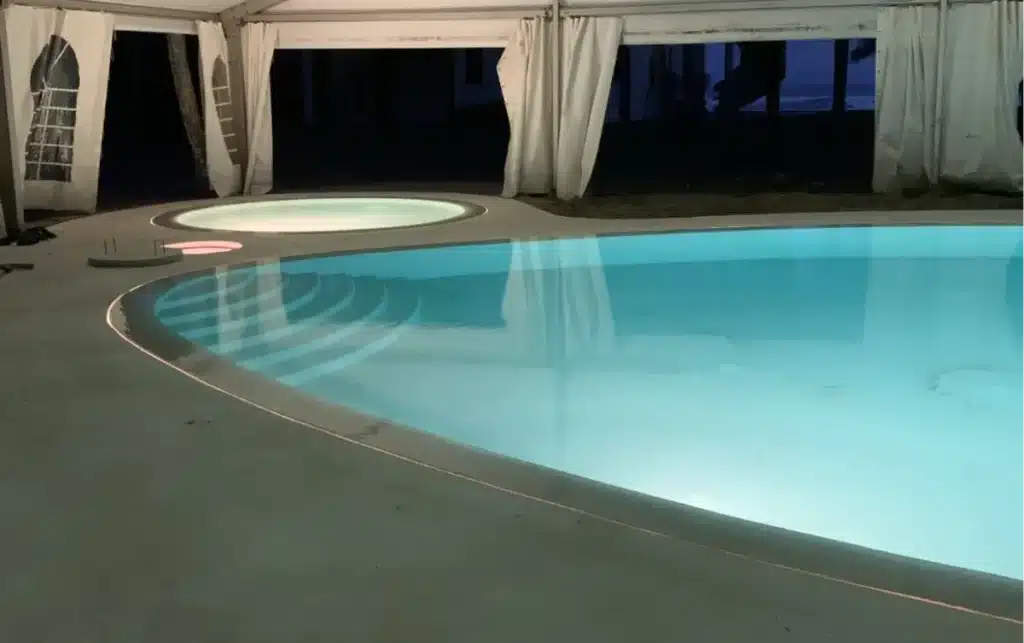
In a zero-edge or perimeter overflow pool, water spills over all four sides simultaneously. A continuous peripheral channel runs around the entire basin, collecting water from every edge. The water surface sits flush with the surrounding deck, creating the mirror effect characteristic of this pool type.
A narrow slot at deck level allows water to overflow continuously into the channel below – the continuous water flow preventing any significant debris accumulation. A decorative stainless steel grate is the alternative where the slot solution is not retained.
The infinity pool
In an infinity pool, water overflows on one or more sides, running down the wall or sheeting over the edge in a controlled cascade. The gutter sits directly below the overflow edge, collecting the falling water.
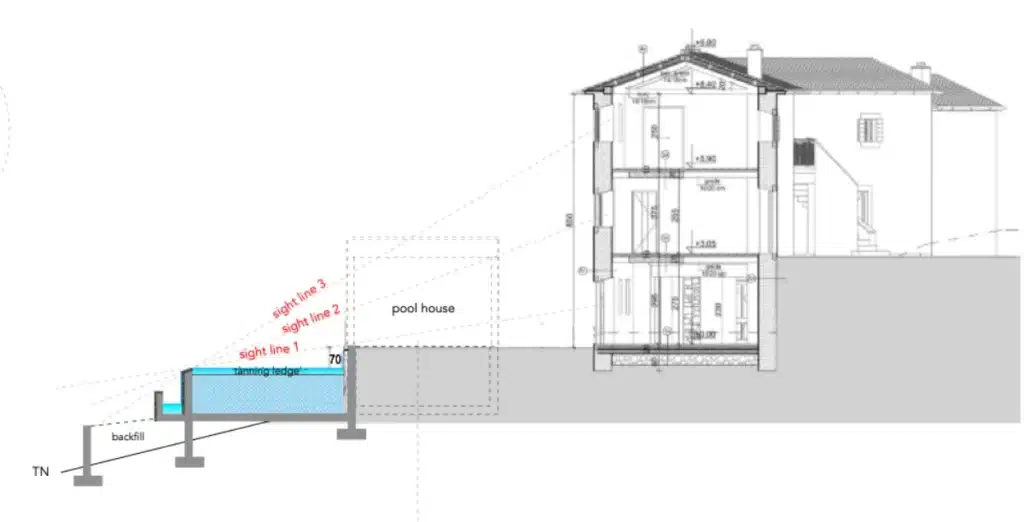
The depth and width of the gutter are calculated against the sight lines from the terrace and the house. The gutter must fall entirely outside the observer’s cone of vision from any occupied position – standing or seated. This is a geometric calculation made at the design stage, not an aesthetic adjustment made during construction.
From gutter to surge tank – the hydraulic rule
In all overflow pool configurations, water collected in the gutter must return to the filtration circuit. In most cases it flows by gravity to a separate surge tank – also called a balancing tank – from which the filtration pump draws. The surge tank absorbs the volume variations caused by bather load, evaporation, rainfall and thermal expansion.
In an infinity pool, the gutter dimensions can sometimes be sufficient to serve as the surge tank directly, feeding the filtration pump without a separate tank. This reduces excavation volume and simplifies the hydraulic circuit. In a zero-edge pool, the peripheral channel is generally too narrow to fulfil this function and a dedicated surge tank is always required.
Construction methods
Prefabricated gutters
Prefabricated gutters – manufactured in PVC, galvanised steel or stainless steel – are used primarily in concrete or masonry zero-edge pools. They can be installed during new construction or as part of a renovation. Depending on the manufacturer, the prefabricated unit may incorporate a surge tank or simply collect and route water to a separate tank. However, prefabricated solutions are limited to standard geometries and are not available in all markets – for free-form pools or projects in regions where these products are not distributed, a cast-in-place concrete gutter is the only viable option.
Cast-in-place concrete gutters
The cast-in-place gutter is the reference construction method for high-end overflow pools. Built using the same techniques as the main basin – shotcrete, formwork and poured concrete – it forms a monolithic connection with the pool structure. For shotcrete pools, gutter and basin are constructed simultaneously. For poured concrete or concrete block pools, the gutter formwork and pour follow the main basin construction.
Waterproofing follows the same specification as the pool interior: polymer-modified render, reinforced PVC membrane, or polyester resin with fibreglass reinforcement and gel coat. In most cases, the pool finish and the gutter lining are identical. PVC liner is technically possible but not recommended – the tight angles and mechanical constraints compromise long-term durability.

Gutter covers
In a zero-edge pool, the gutter must be covered for safety. The choice of cover is an architectural decision as much as a technical one – it must integrate seamlessly with the deck material, the pool finish and the overall geometry of the surround.
The slot solution, where a narrow opening is integrated flush with the deck surface, is the most commonly specified on high-end projects. It maintains visual continuity and is effectively self-cleaning – the continuous water flow carries debris through without accumulation. The stainless steel grate is the alternative where a wider opening is preferred, though it requires more regular maintenance and reads more visibly against the deck.
For timber deck surrounds, cover design requires particular attention – the junction between wet and dry zones, thermal movement and fixing details all affect the long-term result.
In an infinity pool, the gutter can be left open or fitted with a cover to limit debris entry, depending on the site environment and the surrounding vegetation.
Concealment – the architectural challenge
The gutter is a hydraulic necessity. Making it disappear is a design obligation.
In a zero-edge pool, the slot cover handles most of the concealment – water overflows through a gap that reads as a shadow line rather than a technical element. The challenge lies in the junction details: how the cover meets the deck material, how the deck material meets the pool coping, and how the overall plane reads from every viewing angle around the basin.
In an infinity pool, concealment is a geometric problem. The gutter sits below the overflow edge, and its width and position are calculated so that it falls outside the cone of vision from every occupied position on the terrace or inside the house – standing or seated. This calculation is site-specific: the distance from the observer to the overflow edge, the height difference between terrace and pool deck, and the angle of the slope all determine the minimum depth at which the gutter becomes invisible. It cannot be estimated on site – it must be resolved on the drawings before construction begins.
The gutter within the wider hydraulic circuit
The gutter is one element in a circuit that must function as a whole. In a zero-edge pool, water collected in the peripheral channel flows by gravity into the surge tank below. From there, the filtration pump draws water through the bottom drain, sends it through the filter, then through the disinfection and heating systems, and returns it to the pool via the inlet fittings.
In an infinity pool, the circuit follows the same logic – with the gutter feeding into the surge tank, or acting as the surge tank directly where dimensions allow. In both cases, the pump flow rate, pipe sizing, surge tank capacity and gutter dimensions must be calculated together. An undersized gutter creates flow restriction at the entry point of the circuit. An undersized surge tank causes pump cavitation during peak bather load or heavy rainfall.
The hydraulic design of an overflow pool is not a series of independent specifications – it is a single calculation that starts with the overflow edge and ends at the return inlets.
Morana’s advice
The gutter is not a detail added at the end.
Its size, its position and how it is hidden are fixed on the first drawing, with the edge and the tank.
Frequently asked questions: overflow pool gutter
What is the difference between a gutter and a surge tank in an overflow pool?
The gutter is the channel that takes the water as it leaves the edge. The surge tank, or balancing tank, stores that water and feeds the pump. In most pools the gutter runs by gravity into the tank. On some infinity pools the gutter is sized to do both, and there is no separate tank.
Can the gutter act as the surge tank in an infinity pool?
Yes, if its volume can take the water from bathers, rain and the pump cycle. It then feeds the pump directly. That depends on the length of the edge, the number of bathers, the flow and the climate. It is calculated for each pool.
Does an overflow pool gutter need to be deep?
No. The gutter is a passage, not a store. Water moves through it. What sets its size is the number and diameter of the outlets to the tank. They have to take the full flow without the channel backing up.