
What defines a lagoon pool
A lagoon pool draws its reference from the natural lagoon: shallow entry, curved organic form, variable water depth, and a visual connection with the surrounding landscape. Unlike a rectangular pool, there is no standard template – each project is shaped by the available space, the topography, and the intended use.
The form is free, but not arbitrary. The shape of the pool determines how water circulates, where return inlets must be positioned, and how the overflow edge – if specified – can be integrated without disrupting the visual continuity of the design. A lagoon pool that looks natural on the surface requires precise hydraulic planning beneath it.
Shape and hydraulic constraints
In a rectangular pool, water circulation is predictable: return inlets are symmetrically positioned, flow is balanced, and dead zones are easy to avoid. In a free-form lagoon pool, the irregular perimeter creates areas where water movement is naturally weaker – particularly in concave sections and narrow bays.
Avoiding dead zones requires careful inlet positioning based on the specific geometry of the pool. The number and location of return inlets, the flow rate of each, and the direction of the jets must all be calculated for the actual shape of the basin – not approximated from a standard layout.
Variable depth adds another layer of complexity. Shallow areas heat up faster and require stronger circulation to prevent algae growth. Deep zones need adequate floor return coverage. Where a tanning ledge or children’s area is integrated into the design, the hydraulic plan must account for each zone independently.
The lagoon infinity pool
When an overflow edge is added to a lagoon pool, the hydraulic requirements increase significantly. A perimeter overflow – where water spills continuously along the full curved edge – requires a balance tank sized for the complete overflow length, not just one side.
The free-form geometry of a lagoon pool makes the overflow channel design particularly demanding. On a straight infinity edge, the overflow weir is a single horizontal line. On a curved perimeter, the weir must follow the form of the pool precisely – any variation in level creates an uneven water sheet and breaks the visual effect.
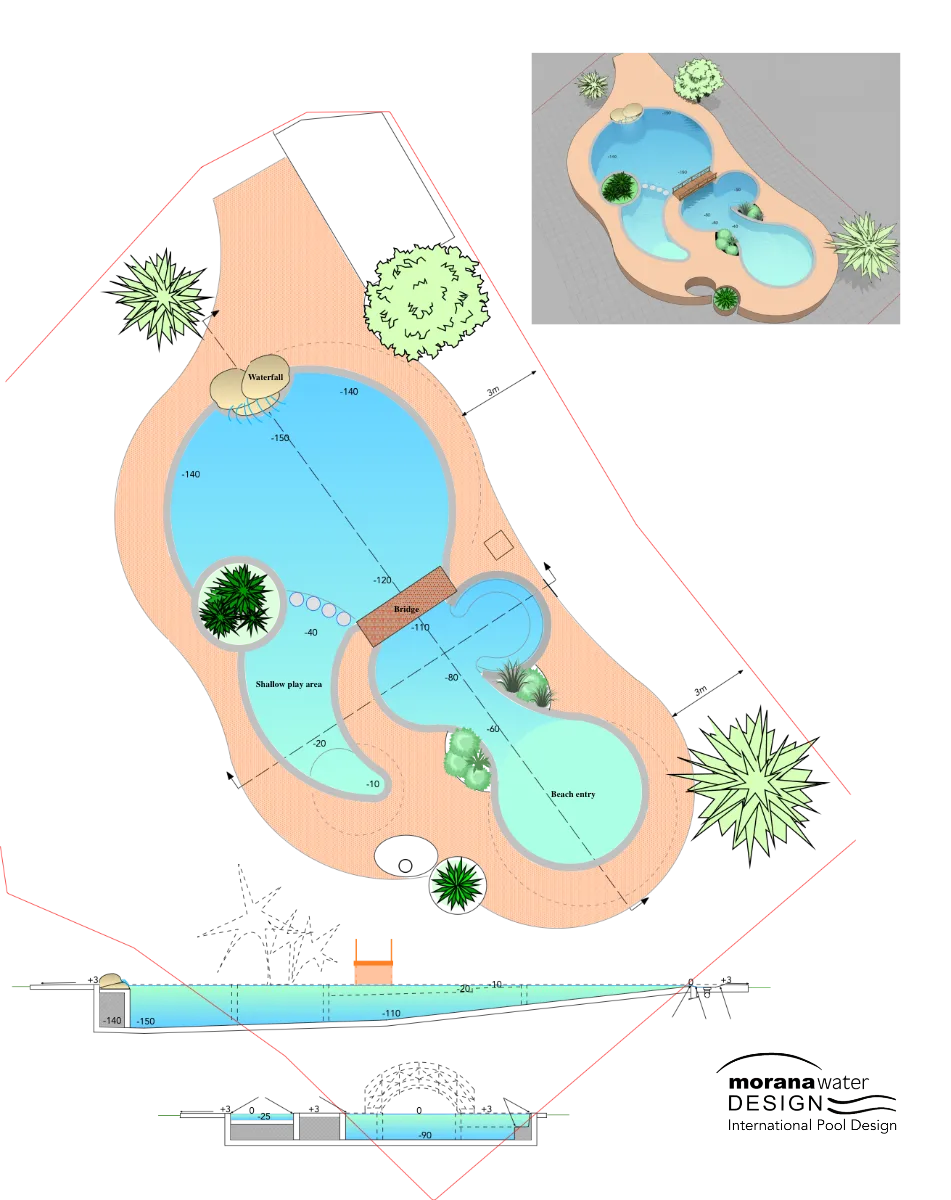
variable depth zones, beach entry, children’s area and zero edge
Surface finish and visual result
The lining choice in a lagoon pool has a direct impact on the visual result. To replicate the colour shift of a natural lagoon – pale turquoise in shallow water, deeper blue as the depth increases – a sand or beige-toned finish is typically specified. The colour of the water changes with depth, creating the gradient effect characteristic of a natural lagoon.
Mineral finishes with silica or marble aggregate are the preferred option: they are non-slip, durable in pool water chemistry, and their texture enhances the natural appearance. Glass beads added to the mix increase light reflection and intensify the colour of the water. Tiles, mosaic and PVC liners are generally avoided – their joints and uniform surface work against the organic aesthetic.
Pool fittings – inlets, drains, vacuum sockets – should be specified in stainless steel or in a colour matched to the lining. Visible fittings in a contrasting colour interrupt the continuity of the pool floor and undermine the natural effect.
Entry and pool surrounds
Entry into a lagoon pool follows the logic of a natural beach: a gentle slope rather than steps or a ladder. The submerged entry creates a shallow zone that serves as a relaxation area, a children’s area, and a transition between the pool surround and the water.
The slope gradient must be designed carefully – too steep and it loses the beach feel, too shallow and it creates an oversized shallow zone that is difficult to circulate effectively. The surrounding landscaping – natural stone edges, rocks, vegetation – is specified in parallel with the pool design to ensure the pool and its setting read as a single composition.
Morana's advice
A lagoon pool is one of the most demanding pool forms to design well. The free-form shape, variable depths, and optional infinity edge each add layers of hydraulic complexity that a standard pool layout cannot accommodate. The visual result – a pool that reads as natural and effortless – is the product of precise engineering decisions made long before construction begins.