
Why sloping ground suits an infinity pool
On a flat site, the vanishing edge effect is engineered: the pool level and terrace levels are carefully managed to create the illusion of water extending to the horizon. On a sloped site, whether a gently graded garden, a hillside plot, or a sloped yard overlooking a valley or the sea, the effect is given by the terrain itself. The drop in level creates a natural horizon line that the pool can exploit directly.
This is why sloping ground is not an obstacle to an infinity pool. It is frequently the condition that produces the most spectacular results. The steeper the slope and the more open the view, the more powerful the visual effect of the overflow edge.
The slope also opens up overflow configurations that are impossible on flat ground. On a site with a significant drop on one side and level ground on the other three, it becomes possible to design a pool with an infinity edge on the view side, where water spills continuously over the vanishing edge, and a zero-edge or mirror configuration on the remaining three sides. The pool reads as a still reflective surface from the house and as a pool that dissolves into the landscape from the overflow edge. This combination is exceptional and can only be achieved when the topography creates the right conditions.
In Mediterranean landscapes, where terraced hillsides, known locally as ‘restanques’ or ‘bancales’, have shaped the terrain for centuries, this type of pool finds its most natural expression. The pool becomes part of a long tradition of working with the slope rather than against it.
Structural considerations
Building on a slope introduces structural challenges that do not exist on flat ground. The most significant is the differential pressure on the pool shell: the uphill side of the pool is partially or fully embedded in the slope, while the downhill side may be partially exposed or cantilevered. The two faces of the shell are working under very different load conditions, and the structural design must account for both.
Retaining walls are often required to stabilise the slope before pool construction can begin. Their design, dimensions, reinforcement and drainage depend on the soil type, the height of the retained earth, and the presence of groundwater. A geotechnical assessment is not optional on a sloping site: soil conditions determine what can be built and how.
Drainage is equally critical. Water that runs down the slope must be directed away from the pool shell and the plant room. Poorly managed surface water can undermine retaining structures, create uplift pressure on the pool floor, and cause long-term movement in the surrounding ground. These risks are resolved at the design stage, not corrected after construction.
Building on a slope is generally more expensive than on flat ground. The additional costs come from earthworks, retaining wall construction, more complex pipe routing, and the geotechnical assessments required before design can begin. That said, a sloped site eliminates the need to engineer the vanishing edge effect artificially — the topography creates it directly, which can simplify the overflow design and offset some of the hydraulic complexity.
Hydraulic design on sloping ground
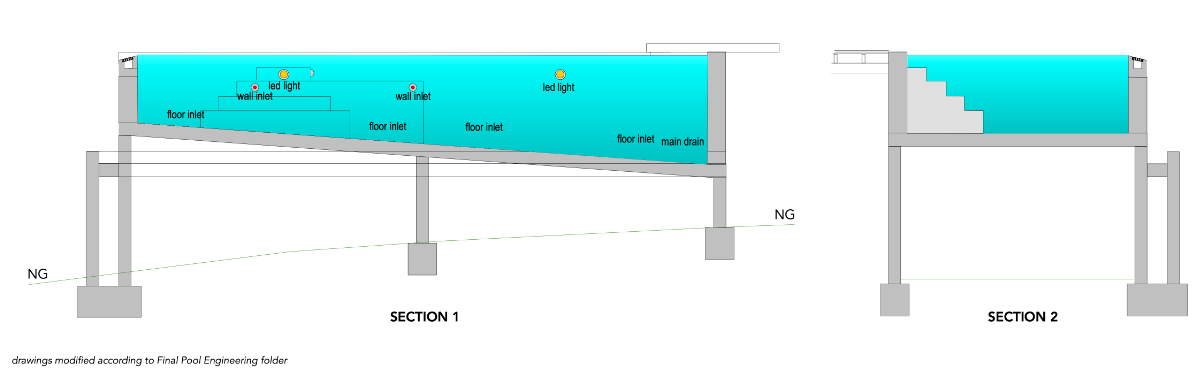
The hydraulic system of an infinity pool on a sloping site must account for the topography from the outset. The position of the balance tank relative to the pool shell, the routing of pipes across a sloped sub-base, and the location of the plant room all interact with the gradient of the site.
On a sloped site, the plant room and balance tank are typically positioned at the lowest available point, at the same level. The overflow water flows by gravity from the gutter into the balance tank, from which the filtration pump draws the water. On sloping sites, the gutter itself can sometimes serve as the balance tank, sized and positioned so that it remains invisible from the terrace and the house.
As with any overflow pool, the hydraulic circuit design is critical to achieving the intended result. Pipe routing, flow velocities and pressure balance across the circuit determine the quality of the overflow line, and these decisions must be resolved in the hydraulic drawings before construction begins. Once the pipes are buried, nothing can be corrected without breaking the structure.
Which overflow configuration works best on a sloping site?
The gradient of the site determines which overflow configurations are feasible and which produce the most compelling visual result.
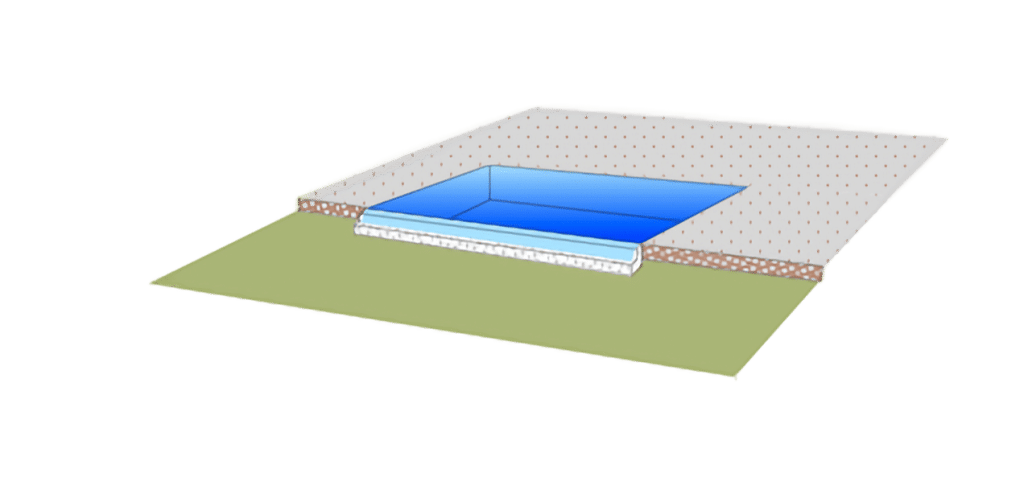
On a gently sloped site, up to approximately 10% , an infinity edge on the downhill side is the natural solution. The three remaining sides can be finished with conventional coping or a zero-edge detail depending on the relationship with the terrace and the house. This configuration is the most economical in terms of construction and hydraulic complexity, and it maximises the view towards the horizon from the water.
On a steeper site, the drop justifies a more ambitious configuration: overflow on three sides, with the fourth either treated as conventional coping or as a zero-edge feeding a discreet gutter along the terrace. Each overflowing side aligns with a specific view axis. The pool reads as three horizons instead of one. The fourth side becomes the entry point, where the water is either contained by the coping or continues the mirror effect flush with the deck.
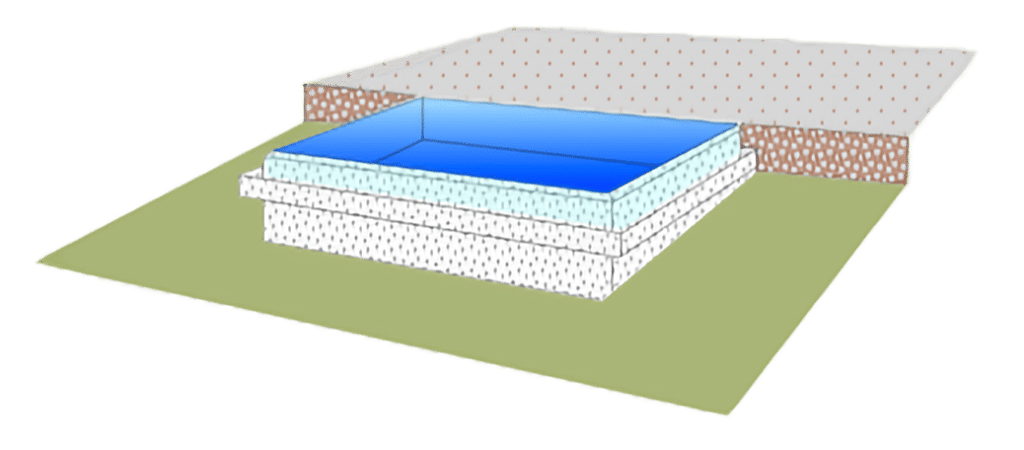
In both cases, the overflow edge on the downhill side must be designed to produce a clean, continuous water sheet across its full length. On an elevated or exposed hillside site, wind exposure and pressure conditions specific to the location must be factored into the overflow profile geometry.
What assessments are needed before building a pool on a hillside?
The success of an infinity pool on a sloping site depends more than any other project type on the quality of the preparatory work.
A topographical survey establishes the exact gradient of the site, the position of boundaries and existing structures, and the relationship between the proposed pool level and the surrounding terrain. Without it, pool levels and terrace levels cannot be set correctly, and the overflow configuration cannot be designed with confidence.
A geotechnical study characterises the soil, its bearing capacity, its drainage properties, and its behaviour under load. On a sloped site, it also identifies any risk of movement or instability that could affect the pool structure over time. On sites with significant gradient, this study is essential before any structural decisions are made.
Planning and permit requirements vary by jurisdiction and by the scale of the works. On sloped sites, retaining walls and significant earthworks frequently trigger permit requirements that do not apply to standard pool projects. These constraints must be identified before the design is finalised.
For an overview of how site conditions shape pool positioning decisions more broadly, see our article Swimming Pool Positioning.
Morana's advice
A sloping site rewards precision. The same topography that creates the conditions for a spectacular infinity pool also amplifies the consequences of errors in structural design, hydraulic sizing, or level setting. A pool on flat ground can absorb small inaccuracies. A pool on a hillside cannot.
The preliminary assessments, topographical survey, geotechnical study, hydraulic planning, are not procedural steps. They are the foundation of every decision that follows. A project that begins with thorough site analysis is a project that can be built with confidence, wherever in the world it is located.
Frequently Asked Questions — Infinity pool on a hillside
How much slope is needed for an infinity pool to make sense?
A gentle slope of about 10% is the point where an infinity edge starts to make sense. Below that, the drop is too small for the vanishing edge to be seen from the terrace. On steeper ground, the effect is fully justified: the overflow shows the landscape below, and the slope becomes an asset rather than a constraint.
Why does the top of the overflow wall need to read as a single line?
That line is what you see from the terrace and from the house. If the wall is a sharp horizontal edge, the water seems to end at the sky, and the mirror effect works. If the line breaks anywhere along its length, or if the top of the wall is thick enough to catch the light differently, the effect fails. The pool then looks like a container of water, not a horizon.
Can an infinity pool have more than one overflowing side on a hillside?
Yes. One overflowing side is the most common choice on a sloped site. A corner plot or a promontory can justify overflows on two or three sides, each one aligned with a view. This is a design decision, made by reading the site, not a technical constraint. The more sides that drop into open landscape, the more the pool joins its surroundings.