
Converting Your Skimmer Pool to an Overflow Design
Complete Transformation Guide
Converting a traditional skimmer pool into an overflow design represents one of the most dramatic transformations possible in pool renovation. This architectural metamorphosis doesn’t merely upgrade your pool—it fundamentally reimagines the relationship between water, landscape, and living space.
Why Convert Your Pool to an Overflow System?
Regular skimmer pools, whilst functional, create visual boundaries that interrupt the flow between pool and surroundings. The raised coping, visible skimmer boxes, and defined waterline can feel dated and utilitarian. An overflow conversion eliminates these visual barriers, creating seamless integration with your outdoor environment.
The transformation brings architectural elegance where water appears weightless and integrated with its surroundings. Enhanced property value follows naturally, as overflow pools command premium valuations in today’s market. Beyond aesthetics, overflow systems provide superior water quality through better circulation and filtration, whilst contemporary design transforms dated pools into modern architectural features with improved functionality and easier maintenance.
Assessing Pool's Conversion Potential
Not every pool can be successfully converted to an overflow design. The feasibility depends on several critical factors that must be evaluated before beginning any transformation.
Concrete pools represent the ideal candidates for conversion. Reinforced concrete structures can be modified to accommodate overflow systems, provided the shell remains structurally sound. Any cracks or movement issues must be addressed prior to conversion. Prefabricated kit pools require careful assessment, as fibreglass pools can be adapted though modifications are more limited than with concrete structures. The key lies in ensuring the existing structure can support the new hydraulic demands.
Site conditions play a crucial role in determining conversion success. Sloped sites work perfectly for infinity edge effects where water appears to merge with distant views, whilst flat sites prove ideal for mirror effects where water sits flush with surrounding surfaces. Adequate space is essential for balance tank installation, typically beneath the pool deck or in adjacent areas.
Existing pool depths, skimmer positions, and filtration equipment locations all influence conversion feasibility. Pools with adequate depth (minimum 1.3 metres) and appropriate structural access provide the best foundation for transformation.
The pool Conversion Process: Technical Implementation
Converting a skimmer pool to overflow design follows a systematic approach that addresses structural, hydraulic, and aesthetic requirements.
Design and assessment phase
The process begins with comprehensive assessment of existing structure and filtration systems to determine what can be retained and what requires modification. Research and design work focuses on selecting the optimal overflow system type (infinity, zero-edge, or mixed design) based on site conditions and client preferences. This phase also involves integrating new inlet systems for optimal overflow operation, calculating flow rates, positioning new return jets, and ensuring perfect hydraulic balance throughout the pool. Modifications for enhanced pool integration with surrounding architecture and landscape are carefully planned during this stage, alongside necessary upgrades to circulation capacity.
Implementation and construction
Overflow gutter integration and balance tank installation represent the most complex phases of conversion. The channel must be precisely constructed with tolerances of ±1mm for proper operation, whilst the balance tank requires careful sizing and positioning to manage water displacement and system demands. Access for maintenance and proper waterproofing are essential considerations during this phase.
Where desired by clients, the conversion provides an excellent opportunity to integrate staircases or immersed beach entries, replacing dated ladder access with contemporary, comfortable entry systems that enhance both aesthetics and functionality.
Throughout the process, detailed execution plans are prepared identical to those for new pool construction, ensuring perfect implementation by construction teams. These plans specify every technical detail from hydraulic connections to structural modifications, leaving nothing to chance.
Morana's advice 👇
You don’t have to build when you can renovate
Water shortages have caused some local authorities to ban new swimming pools construction for the foreseeable future. Instead of tearing down and rebuilding, renovate where possible.
Analyzing the problems
The renovation process begins with a complete inventory of the pool. As a result, the necessary work can be performed.
Make sure your pool renovation is done right.
The Conversion Process: Technical Implementation
Before
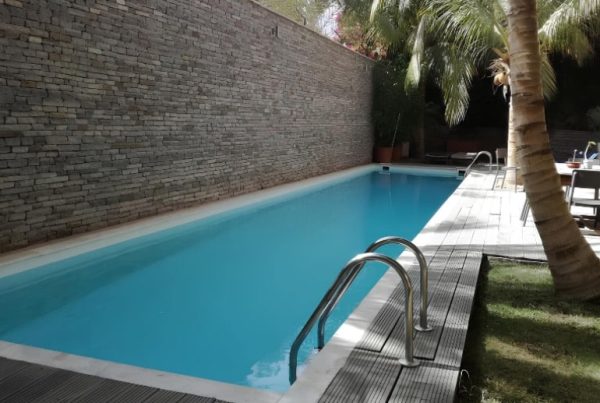
This rectangular pool, equipped with two skimmers, had visibly aged. The once-bright blue tiles had faded, the stone coping appeared weathered, and the stainless steel ladders lent it a dated, utilitarian character.
The contrast with the lush garden was striking. Surrounded by coconut palms and vibrant tropical vegetation, the pool no longer harmonised with its environment and clearly required a new identity.
After

The transformation proved remarkable: the water now mirrors the surrounding palm trees and blends seamlessly into the garden. The new overflow edge has replaced the old skimmers, creating a calmer and more refined atmosphere. From a technical perspective, the filtration system was enhanced with heating, salt chlorination, and automatic pH control. The result is an infinity design that is not only more elegant but also more comfortable and easier to maintain.
The process
We replaced the existing skimmers with a 3.5-metre overflow running across the pool’s width, allowing water to slip quietly into a concealed balance tank. The stainless steel ladders were replaced by a masonry staircase, offering greater comfort and superior integration within the overall design. The old blue tiles were substituted with dark-grey reinforced polyester lining, transforming the water colour to vibrant turquoise that complements the tropical setting. Around the pool, exotic IPE decking was installed flush with the water surface, eliminating the heavy coping stones and giving the entire space a sleek, contemporary character that blends naturally with the garden.
Investment Considerations
Converting an existing pool to overflow design typically requires investment equivalent to 60-80% of new overflow pool construction. The cost varies significantly based on structural complexity, site conditions, finish specifications, and technical upgrades required. Concrete pools generally cost less to convert than prefabricated units requiring extensive modification.
Return on investment proves compelling, with overflow pool conversions typically adding 15-25% to property values, often exceeding the conversion investment. For luxury properties, the percentage increase can be substantially higher as overflow pools are expected at premium price points.
Discover our comprehensive analysis of infinity pool advantages and what makes them truly special to evaluate the full value proposition of your conversion project.
Professional Expertise requirements
Professional expertise is essential for successful conversion. The project requires specialised knowledge of hydraulic engineering, structural modifications, and aesthetic integration that generic pool contractors often lack. Precise hydraulic calculations, structural engineering for modifications, balance tank sizing and positioning, and integration with existing site drainage all demand experienced specialists.
Construction tolerances for overflow pools are significantly tighter than traditional pool building. Edge levelness within ±1mm, precise flow calculations, and proper waterproofing demand experienced specialists familiar with overflow pool requirements.
Conclusion: Transforming Vision into Realitys
Converting your skimmer pool to an overflow design represents more than renovation—it’s architectural transformation that reimagines your outdoor living space. The combination of enhanced aesthetics, improved functionality, and increased property value makes conversion a compelling investment for discerning homeowners.
Success depends on proper assessment, specialised design, and expert implementation. The technical complexity requires professional expertise, but the results justify the investment through enhanced beauty, functionality, and property value. When executed with proper expertise and attention to detail, your converted overflow pool becomes not just a swimming facility, but a stunning architectural element that defines your outdoor environment.
Ready to Transform Your Pool?
With over 30 years of specialised experience in overflow pool design and conversion, we guide homeowners through every aspect of pool transformation. Our international consulting services ensure your conversion project achieves both technical excellence and architectural distinction.