
During the pool’s design steps, the piping layout in the pool plant room is often forgotten. Why? Because it is the least visible and least funny part. However, this is where the miracle does happen: the one that allows you to swim in clear, healthy, and possibly heated water. Therefore, drawing the plant room according to the planned equipment and drawing the piping layout, including fittings, valves, and materials, is necessary. We enlighten you on this point.
Plumbing an Infinity Pool: A System, Not Just a Technical Room
Plumbing an infinity pool is not limited to assembling equipment inside a plant room — but this is where the system takes physical form.
It is a system-wide organisation that connects the pool basin, the overflow mechanism, the balance tank and the filtration equipment into a single, coherent circuit.
Each element influences the others. Pipe routing, distances, flow direction and water levels must be considered together to preserve hydraulic balance and ensure long-term reliability.
This is why a plumbing layout should never be approached as a secondary technical step, but as an integral part of the pool’s overall conception.
Designing The Pool Plant Room
The pool plant rooms house the pumps, filters, water treatment equipment, and heaters. However, the installation of most heat pumps is outside the room.
Defining the Right Size for the Plant Room
The water volume of the pool and the room’s dimensions are related. For example, the larger the size of the pool, the larger the diameter of the filter will be. If the pool is significant, you might need to install two pumps or more. The plant room size must allow easy maintenance of the equipment.
The room height should be enough to stand upright; six feet high is a good balance.
Choosing the Right Location for the Plant Room
The further away from the pool, the plant room is, the higher the pump’s power should be. To avoid excessive pressure losses, it is advisable to place the pump lower than the pool’s water level.
The best option is in the ground near the pool. In this case, steps or a ladder must allow access to the room. The simultaneous concrete construction of the pool and the room is often a good choice.
Note: the storage of products such as chlorine or pH regulator is not advised in the technical room. Air ventilation is highly recommended.
What the Pool Plant Room Must Contain
Essential equipment for an infinity pool
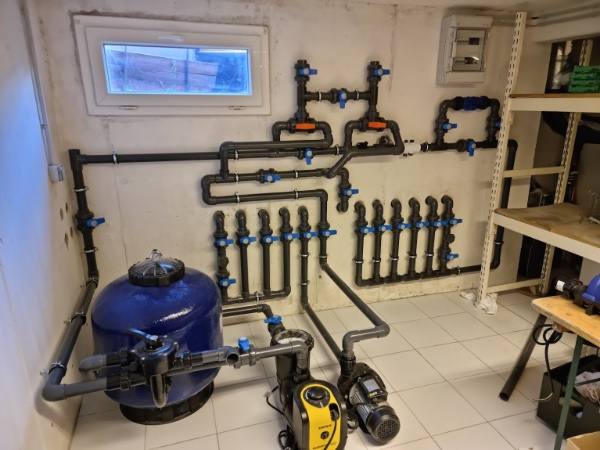
This generally enclosed space is designed to receive the various equipment of the filtration system:
- The filtration pumps. You may need one or more depending on the water volume. The flow rate of each also relies on the swimming pool size. For an overflow pool, you have to consider other parameters, such as the length or the kind of overflow. Wires are connected to the electric board.
- The filter with its filtering load (sand, recycled glass, diatoms earth, or cartridge). Its size is directly related to the flow rate of the pump.
- The electrical panel provides power and controls the equipment
- The water level control box for overflow pools
- All the plumbing for the pool plant room, including pipes, valves, and fittings.
Optional Equipment and Budget Phasing
These equipement are optional:
- The automatic sanitization equipment, e.g., salt chlorinator, generally needs a connection to the switchboard.
- The pH regulation
- The heating system or the by-pass when using a heat pump installed outdoors. Wires connect to the electric panel.
The plant room must be easily accessible to the user to facilitate maintenance operations. Access must be prohibited to children.
Professional insight 👇
Organise the installation
To avoid overlapping pipes and inaccessible valves, the filtration system should follow a clear, logical sequence. Proper pipe labelling makes future maintenance far easier.
Plan for future equipment
By integrating by-passes into the pump room layout, certain systems — such as heating or disinfection — can be installed later, allowing the budget to be phased without compromising performance.
Are you looking for a plant room design tailored to your pool
Why a Plumbing Layout Matters in an Infinity Pool
In an infinity pool, water behaviour is far less forgiving than in a conventional skimmer pool.
Small inconsistencies in pipe routing, valve positioning or flow direction can disrupt circulation, create uneven water levels or compromise the overflow effect.
A well-designed plumbing layout ensures that every component works in harmony:
water collection remains stable, filtration operates efficiently, and return flows are evenly distributed.
Beyond performance, a clear layout also simplifies installation, maintenance and future upgrades. It allows plumbers to work methodically, reduces unnecessary fittings, and limits pressure losses throughout the system.
Understanding the External Plumbing Circuit
The plant room is only one part of the plumbing system.
What happens outside — between the pool basin, the overflow edge and the technical room — is equally decisive.
In an infinity pool, water is collected through overflow gutters or weirs before being directed towards the balance tank and filtration system. From there, it is returned to the pool through carefully positioned inlets.
This external circuit must be designed with clarity: pipe paths should be as direct as possible, diameters must be consistent, and flow directions clearly identified.
When properly organised, this circuit supports stable water levels, smooth circulation and the visual calm expected from an infinity pool.
How an Infinity Pool Filtration System Works
Regular or overflow pools operate more or less the same way. Water goes out through the skimmers or the weir and returns to the pool through the inlets. However, to ensure safe and clear water, it is necessary to filter and sanitize it regularly, at least every four hours. It is the task of the equipment installed in the plant room.
Setting Up Plumbing Inside the Plant Room
Let’s be clear, if you build a regular pool without any particular option, the connection is simple. However, installing an overflow pool filtration with disinfection equipment and a heater gets more complicated.
To connect a pump to a filter, you use PVC pipes and fittings. Schedule 40 (SCH 40) PVC pipes are the most commonly used. SCH80 pipe has thicker walls and can handle higher pressures.
The wiring of the motor to the electrical box, you have to follow the constructor’s instructions.
To warranty that an overflow pool is working perfectly, you must install securities and check valves. Moreover, the homeowner willing to build such a pool likes to get one fully equipped. It makes the connections more complex. In this sense, the filtration system plumbing and wiring layout should help.
Why a Plumbing Diagram Makes Installation Easier
A plumbing layout defines how the system should work.
A plumbing diagram shows how to build it.
In infinity pools, where safety devices, check valves and overflow circuits must be precisely positioned, a diagram removes ambiguity. It clarifies the sequence of connections and helps installers understand the logic behind the system rather than improvising on site.
This is particularly valuable when working with plumbers or contractors who are not specialised in swimming pools.
With a clear diagram, installation becomes straightforward, reproducible and reliable.
If you are looking for a broader, system-level explanation of pool plumbing diagrams — including overflow and infinity pool circulation — you can also read our guide on swimming pool plumbing diagrams.
Selecting Pumps, Filters and Optional Equipment
Pump Sizing and Flow Logic
To get a filtration unit perfectly calibrated, you have to consider the pool area and the water volume. The distance between the pool and the plant room must also be considered. The climatic conditions (temperature, wind, rains), and the number of bathers, at least for those receiving the public. All this is quickly done using simple calculations and the pump efficiency curve.
Note: The performance of a pump depends, of course, on its power and manufacture. That’s why we prefer to list a pump’s flow rate rather than its power. It is helpful to have a guide filled with tips for choosing a pump, plumbing, and wiring.
Equipment Selection Tips
These tips are valid for plumbing an infinity pool but also a regular pool.
- When selecting a motor, don’t rely on price alone. Choose a pump for which you will always have spare parts.
- Before accepting to pay for 2 or 3 pumps, ensure that it is necessary. One motor is often enough.
- When selecting the filter, do not over-size it.
- The sand filter load is outdated. Go to the recycled glass.
- Pick a filter with a top mount multiport valve if you have limited space in the plant room.
- If you want to heat your pool, ensure that you cover it.
- And much more in our advice guide.
Conclusion: Plumbing as the Backbone of an Infinity Pool
An infinity pool does not rely on appearance alone. Its sense of calm, stability and continuity comes from the way water is collected, filtered and returned — quietly, precisely, and without disruption.
The plant room is only one part of this system. What truly matters is the coherence of the entire hydraulic layout: pipe routing, flow balance, safety devices, and the relationship between the pool, the overflow and the technical equipment.
When these elements are designed together, the system becomes easier to build, easier to maintain, and more reliable over time. The water behaves as expected, the equipment works within its optimal range, and the technical complexity remains discreet — exactly where it belongs.
A clear plumbing layout is not a drawing made at the end of a project. It is a structural decision that shapes how an infinity pool will function, age and be experienced, day after day.
To explore this system-level approach, you can read our complete Infinity Pool Design Guide.
Need a plumbing layout adapted to your infinity pool?
Get a filtration and plant room plan designed for your project.