
What is an overflow pool?
In an overflow pool, water spills continuously over a weir – partial or total – and is collected by a gutter surrounding or running beneath the pool. A balancing tank equipped with a water level sensor compensates for variations caused by bathers, evaporation, and rainfall. From there, a filtration pump returns the water to the pool, maintaining a continuous and stable hydraulic circuit.
‘Overflow pool’ is the technical term describing the water circulation system. ‘Infinity pool’ refers specifically to pools with a vanishing edge effect where water appears to merge with the horizon. All infinity pools are overflow pools — but not all overflow pools are infinity pools.
Types of overflow swimming pools
Choosing the right overflow system depends on several factors: the topography of the site, available space, the relationship between pool and house, architectural style, and the desired visual effect.
For a detailed breakdown of edge types — infinity edge, zero edge and under-coping — and their structural implications, see our guide to overflow pool edge types.
Infinity edge overflow pools
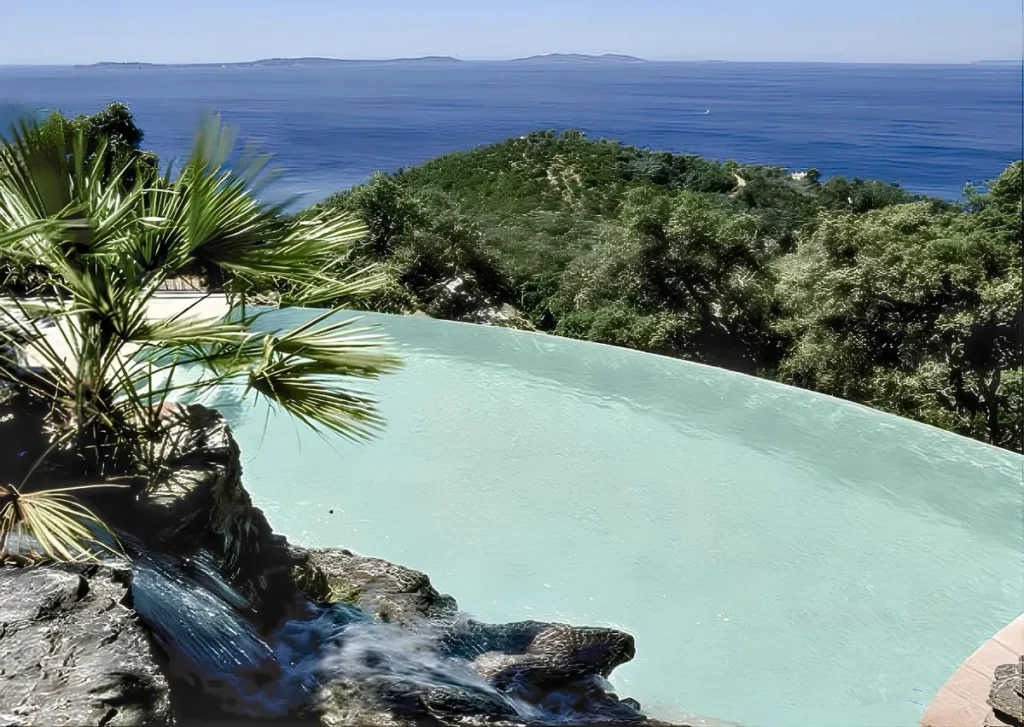
Among all overflow pool configurations, the infinity edge is the most sought-after. The negative-edge weir allows water to flow continuously over the edge, creating the impression that the pool has no boundary – the water line appears to merge with the horizon. The waterfall effect can be modulated to produce a quieter, more discreet flow. On a sloped or terraced site, the visual impact is particularly striking.
Zero edge overflow pools
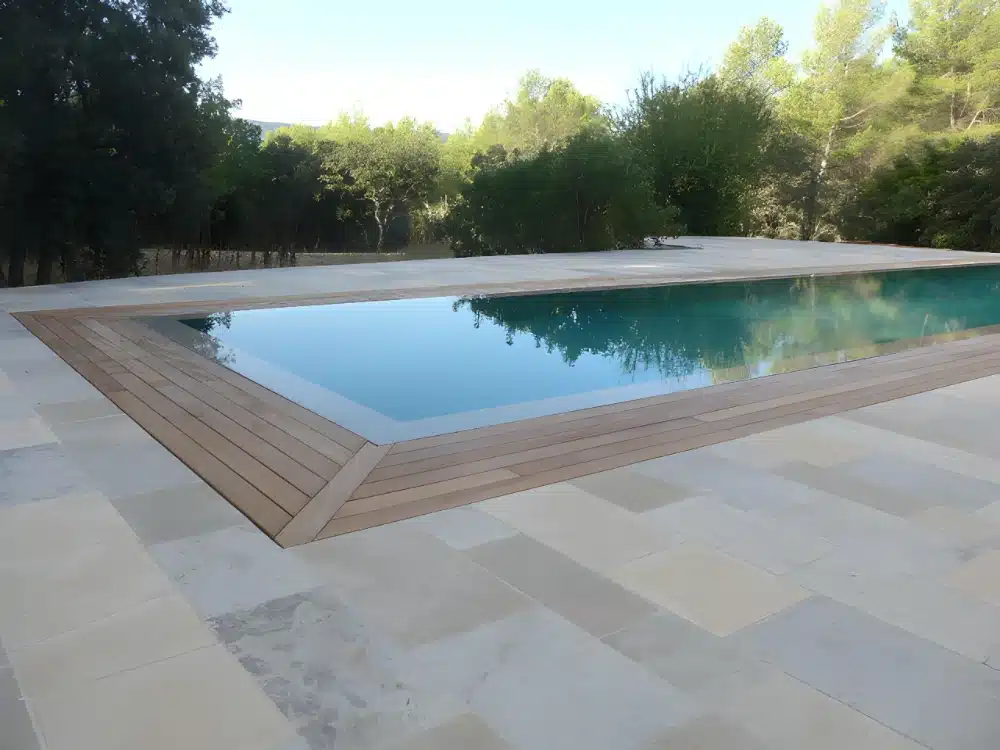
In a perimeter overflow pool, water spills over all four sides. The edges blend seamlessly into the surrounding deck – there is no coping, and the water surface sits at exactly the same level as the terrace. As water spills from the pool, it flows into a channel installed under a slot or grate, then into a balancing tank at a lower level.
This configuration works particularly well in a garden or on a terrace adjacent to the house, creating a calm, mirror-like atmosphere. The reverse slopes of the channel reduce water loss and ensure a quiet, controlled return.
The knife-edge, or Lautner edge: the zero-edge taken to its logical extreme
The knife-edge pool — also known as the Lautner edge — is a refined evolution of the zero-edge configuration. Rather than a flat coping, the pool wall is cast with a sharp, bevelled edge that tapers to a fine point. Water slides along this invisible edge and drops directly into a concealed slot between the pool and the terrace, eliminating any visible masonry transition. The result is a water surface that appears to sit flush with the surrounding deck, with no perceptible boundary between water and stone.
Mixed overflow pool designs
It is possible to combine both systems – a negative edge weir on one side and a perimeter overflow on the other three. This configuration captures a directed view while maintaining the Zen calm of a zero-edge finish on the remaining sides. The visual result is exceptional.
The design and operation follow the same principles as the individual systems. A preliminary design allows you to visualise the result before construction begins.
Note: Contrary to a common misconception, a standard pump is sufficient for overflow pools – no specific pump is required.
Morana’s advice
The overflow type is fixed at the start.
Infinity, zero edge or mixed: each one sets the wall, the gutter and the tank. Changing it later means redrawing the structure.
Overflow pool benefits and disadvantages
The disadvantages
An infinity edge or a zero-edge pool costs more than a skimmer pool. The extra is the gutter, the balancing tank and a filtration system sized for the overflow.
What drives that cost is set out in the cost of an infinity pool. It also needs a designer who knows overflow hydraulics. It is not a job for a general pool contractor without detailed plans.
The benefits
The overflow filtration system prevents impurities from accumulating at the water surface. Leaves, insects and other debris are continuously removed by the overflow. Return inlets at the pool floor ensure better distribution of treatment products and heated water, simplifying maintenance.
A zero-edge pool appears to sit flush with the terrace – the walls dissolve into the water surface. An infinity pool creates the impression that water extends to the horizon, merging with the landscape beyond.
Overflow pool design process
Designing an overflow pool requires more than technical execution. When non-specialised contractors are involved, clarity at the design stage becomes essential. Accurate drawings and well-defined reference levels ensure that the project can be executed correctly, even by teams without specific overflow pool experience.
A preliminary design phase allows the project to be shaped in relation to the site, the surrounding architecture and the intended use of the pool. Decisions about proportions, positioning and visual relationships are established at this stage, long before construction begins.
For a broader, design-led perspective – where proportions, alignment and visual intent are defined before technical decisions – explore our Infinity Pool Design & Construction Guide.
Drawing the plans
In addition to the general plan, section drawings, execution details and hydraulic layouts are required. When calculating the volume of the balancing tank, the dimensions of the pool, the type of overflow and the length of the overflow edge must all be taken into account. The frequency of use is also a factor.
Frequently asked questions: overflow pool types
What is the difference between an infinity edge and a zero edge?
An infinity edge overflows on the view side. The wall is bevelled, with no coping on that side. A zero edge overflows all around, flush with the terrace. There is no coping and no visible rim.
What is a mixed overflow pool?
A mixed pool combines the two. One or more sides are infinity, toward the view. The others are zero edge, flush with the terrace.
What is a Lautner edge?
A Lautner edge is a zero edge taken further. The wall is cut to a knife edge all around, so the rim disappears. It is still a perimeter overflow.